What Is the Largest Whole Number Less Than 100
| Intermediate Algebra WTAMU > Virtual Math Lab > Intermediate Algebra After completing this tutorial, you should be able to:
Have you ever sat in a math class, and you swear the teacher is speaking some foreign language? Well, algebra does have it's own lingo. This tutorial will go over some key definitions and phrases used when specifically working with sets of numbers as well as absolute values and opposites. Even though it may not be the exciting part of math, it is very important that you understand the language spoken in algebra class. It will definitely help you do the math that comes later. Of course, numbers are very important in math. This tutorial helps you to build an understanding of what the different sets of numbers are. You will also learn what set(s) of numbers specific numbers, like -3, 0, 100, and even Above is an illustration of a number line. Zero, on the number line, is called the origin. It separates the negative numbers (located to the left of 0) from the positive numbers (located to the right of 0). I feel sorry for 0, it does not belong to either group. It is neither a positive or a negative number. When graphing a point on the number line, you simply color in a point that corresponds to that number on the number line as illustrated below. That is how you graph a solution on the number line. This is how you would graph it if your solution was the number 2: A set is a collection of objects. Those objects are generally called elements of the set. The symbol So, it stands to reason that We say that A is a subset of B, written A (It does not necessarily mean that every element of B is also contained in A) There are several ways to notate a set, the two most common ways are:
Roster form just lists out the elements of a set between two set brackets. For example, {January, June, July} Set builder notation describes the members of the set without listing them. It is also written between two set brackets. For example, { x | x is a month that begins with J} When writing it in set builder notation you always do the following: start off with a left set bracket, then you put x followed by a vertical bar which is interpreted as 'such that'. Then you write out the description of the elements of the set. Finish it with a right set bracket. So the above illustration would be read: " x , such that, x is a month that begins with J." It is important to know set builder notation, especially in mathematics, because it allows you to group together large number of elements that belong to a certain category. The above set has only 3 elements, so it would not be difficult to write it in roster form as shown above. However, if your set has hundreds or thousands of elements, it would be hard to list them out, but easy to refer to them using set builder notation. For example, { x | x is a college student in Texas}. Before we move on to the math aspect of sets, there is one more term we need to make sure you have a handle on. Empty (or null) set is a set that contains no elements. It is symbolized by { } OR Be careful. It is real tempting to use them together, but { Let's move on to some special sets that pertain specifically to math. Note that the three dots shown in the sets below are called ellipsis. It indicates that the elements in the set would continue in the same pattern. - In other words, the list would keep going and going in that direction using the pattern illustrated. N = {1, 2, 3, 4, 5, ...} Makes sense, we start counting with the number 1 and continue with 2, 3, 4, 5, and so on. {0, 1, 2, 3, 4, 5, ...} The only difference between this set and the one above is that this set not only contains all the natural numbers, but it also contains 0, where as 0 is not an element of the set of natural numbers. Z = {..., -5, -4, -3, -2, -1, 0, 1, 2, 3, 4, 5, ...} This set adds on the negative counterparts to the already existing whole numbers (which, remember, includes the number 0). The natural numbers and the whole numbers are both subsets of integers. Q = { In other words, a rational number is a number that can be written as one integer over another. Be very careful. Remember that a whole number can be written as one integer over another integer. The integer in the denominator is 1 in that case. For example, 5 can be written as 5/1. The natural numbers, whole numbers, and integers are all subsets of rational numbers. I = {x | x is a real number that is not rational} In other words, an irrational number is a number that can not be written as one integer over another. It is a non-repeating, non-terminating decimal. One big example of irrational numbers is roots of numbers that are not perfect roots - for example Another famous irrational number is R = {x | x corresponds to point on the number line} Any number that belongs to either the rational numbers or irrational numbers would be considered a real number. That would include natural numbers, whole numbers and integers. There are two parts to this:
{0, 1, 2, 3, ..., 9, 10} There are two parts to this:
{6, 7, 8, 9, 10} You would not have an ellipsis after the 10 because this set would stop at the number 10. There are two parts to this:
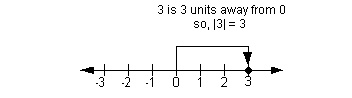
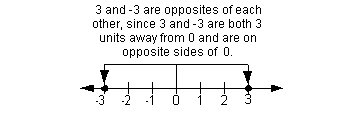
{101, 102, 103, 104, ...} Did you remember to include the ellipsis to show that the set would continue on and on in the same pattern? {-2, -.5, 0, 1/5, 3} When you graph fractions or decimals, you need to first figure out between what two integers it belongs and then estimate, depending on the fraction, where you are going to place the point between those two numbers. In this problem, we have a -.5, which is between -1 and 0. Since it is halfway between these two numbers, I would place the dot halfway between. We also have the fraction 1/5, which is between 0 and 1 and since it is closer to 0 than 1, I would place it accordingly on the graph. The other numbers are integers that are already marked clearly on the graph. Let's see what we get when we graph all of these real numbers: {-4, 0, 2.5, Natural numbers, whole numbers, integers, rational numbers, irrational numbers, and real numbers. Natural numbers? { Note that Whole numbers? {0, Integers? {-4, 0, Rational numbers? {-4, 0, 2.5, Irrational numbers? { These two numbers CANNOT be written as one integer over another. They are non-repeating, non-terminating decimals. Real numbers? {-4, 0, 2.5, 0 ? { x | x is a whole number} Since 0 is one of the elements listed in the set of whole numbers, then it would be true to say 0 -2 ? {2, 4, 6, .... } Since -2 is not listed and the ellipsis would indicate listing out more positive even numbers, it looks like -2 is not part of this set. Therefore, it would be a true statement to say -2 ½ ? { x | x is an irrational number} Since ½ is written as one integer over another, it would be a rational number as opposed to an irrational number. So the true statement would be ½ Since Since not every element of N (natural numbers) is found in I (irrational numbers), then this statement is FALSE. In fact, there are no elements in N that are in I . Since EVERY element of I (Irrational numbers) is also in R (Real numbers), then this statement is TRUE. Since EVERY element of N (Natural numbers) is also in Q (Rational numbers), then this statement is TRUE. Most people know that when you take the absolute value of ANY number (other than 0) the answer is positive. But, do you know WHY? Well, let me tell you why! The absolute value of x , notated | x |, measures the DISTANCE that x is away from the origin (0) on the real number line. Aha! Distance is always going to be positive (unless it is 0) whether the number you are taking the absolute value of is positive or negative. The following are illustrations of what absolute value means using the numbers 3 and -3: When looking for the absolute value of -7, we are looking for the number of units (or distance) -7 is from 0 on the number line. I came up with 7, how about you? When looking for the absolute value of 7, we are looking for the number of units (or distance) 7 is from 0 on the number line. I came up with 7, how about you? This problem has a little twist to it. Let's talk it through. First of all, if we just concentrate on |-2|, we would get 2. Second, note that there is a negative on the OUTSIDE of the absolute value. That means we are going to take the opposite of what we get for the absolute value. Putting that together we get -2 for our answer. Note that the absolute value part of the problem was still positive. We just had a negative on the outside of it that made the final answer negative. Opposites are two numbers that are on opposite sides of the origin (0) on the number line, but have the same absolute value. In other words, opposites are the same distance away from the origin, but in opposite directions. The opposite of x is the number - x . Keep in mind that the opposite of 0 is 0. The following is an illustration of opposites using the numbers 3 and -3: The double negative property reads that for every real number a, -(-a) = a. When you see a negative sign in front of an expression, you can think of it as taking the opposite of it. For example, if you had -(-2), you can think of it as the opposite of -2. Since a number can only have one of two signs, either a '+' or a '-', then the opposite of a negative would have to be positive. So, -(-2) = 2. The opposite of 1.5 is -1.5, since both of these numbers have the same absolute value but are on opposite sides of the origin on the number line. The opposite of -3 is 3, since both of these numbers have the same absolute value but are on opposite sides of the origin on the number line. These are practice problems to help bring you to the next level. It will allow you to check and see if you have an understanding of these types of problems. Math works just like anything else, if you want to get good at it, then you need to practice it. Even the best athletes and musicians had help along the way and lots of practice, practice, practice, to get good at their sport or instrument. In fact there is no such thing as too much practice. To get the most out of these, you should work the problem out on your own and then check your answer by clicking on the link for the answer/discussion for that problem. At the link you will find the answer as well as any steps that went into finding that answer.
|
 Learning Objectives
 (pi) belong to. Some of them belong to more than one set. I think you are ready to go forward. Let's make you a numeric set whiz kid (or adult).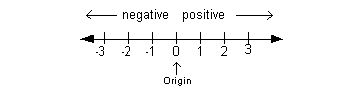

 means 'is an element of.'
  represents 'is not an element of.'
 B, when every element of A is contained in B.
  .
.  | a and b are integers and
 }
} or
or . 17 is not a perfect square -

 ,
, , 11/2, 7}
  ? {
? { 
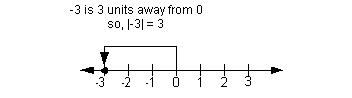

 ,
, }
}
What Is the Largest Whole Number Less Than 100
Source: https://www.wtamu.edu/academic/anns/mps/math/mathlab/int_algebra/int_alg_tut3_sets.htm
0 Response to "What Is the Largest Whole Number Less Than 100"
Post a Comment